Bjornsongatan underpass
Let the Right One InThe Bjornsongatan underpass is a pedestrian passage beneath a street in Blackeberg, a practical shortcut whose darkness makes it a setting for fear, attack, and belated recognition. When Jocke passes through it, the nearest streetlight is broken and the path beneath the road appears as a dark hole. There, among leaves blown into heaps, a voice asks for help; Jocke approaches and finds a curled-up figure. The underpass is also the place Gosta later identifies as the last point where he saw Jocke alive, making its darkness a gap in the neighborhood’s knowledge as well as a physical feature of the scene.
Setting and Approach
The passage lies on Jocke’s route home. He considers avoiding it: the stairs beside the underpass lead up to Bjornsongatan, though taking them would make his journey slightly longer. The choice has a history. Once, drunk, Jocke had imagined a chimney detaching from the commercial laundering center and gliding down a hill toward him; he had hidden on the path until the vision vanished. He usually sleeps with a light on because darkness can provoke such visions when he has been drinking. But on this night he is sober, and the fear has begun to outlast its original conditions. He recognizes that the strange visions are seeping into his sober perception, then admits to himself, “I’m starting to get soft in the head.” The underpass is frightening before anything happens there: its darkness presses on a man already unsure whether he can trust what he sees.
Jocke nevertheless resumes walking through it, trying to imagine a different future. He has decided to go to Tenerife, stay home rather than visit the restaurant, and look through the newspaper advertisements. His plan to leave, and his resolve to pull himself together after eight years, briefly make the passage part of an ordinary return home. Then he hears a moaning voice from the side. His eyes adjust only slowly; at first he can make out the contours of leaves gathered in heaps, and the voice sounds like a child’s. The location withholds the source of the sound until he moves closer, turning the underpass’s darkness into suspense rather than mere scenery.
Jocke’s Encounter
Jocke initially thinks that the Vällingby murderer has come to Blackeberg, but that this time the victim has survived. He does not want involvement: he is on his way to Tenerife, and the imagined new start has begun to take shape. Even so, he approaches the voice. The figure lies curled in a fetal position among the leaves. When Jocke asks what happened, he takes the apparent child into his arms and imagines how the people at the restaurant will react when he arrives carrying her. His private fantasy makes the rescue feel like proof that he is a good person and can begin again.
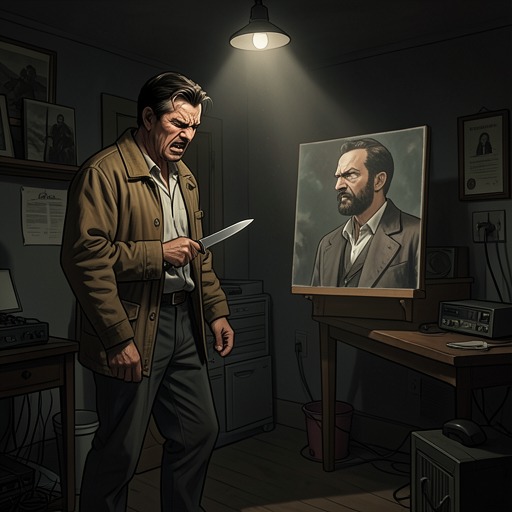
That self-conception collapses as he turns to leave. Pain stings his throat, but he cannot lower the child. Her jaw is pressed against his chin; her hold tightens around his neck, and the pain grows stronger. Jocke feels her jaws working against him and warm blood running down his chest. The underpass’s concealed side space has allowed a plea for help to become an assault at close range. The reversal also darkens his hopeful plans: the scene that seemed to offer him a chance to act generously becomes the moment he is attacked.
Gosta’s Account and the Missing Body
Later, Gosta speaks privately to Giselle about Jocke’s death. He says that he knew Jocke, that Jocke is dead, and that no one else knows because they did not see what he saw. In Gosta’s recollection, a child came down the path and waited for Jocke in the underpass. Jocke went in and never came out; by morning he was gone. Gosta is certain he is dead, even though there is no body there to make that certainty public. The account gives the location a second function: it is where a witness saw the encounter, but also where the evidence of what followed has disappeared.
Gosta’s testimony does not turn the underpass into a fully explained crime scene. Instead, it establishes the limits of what the neighborhood can know. Jocke’s disappearance, the child waiting in the passage, and Gosta’s conviction remain set against the absence of other witnesses and a recovered body. The place links the immediate violence of Jocke’s attack to the later uncertainty surrounding his fate.
Narrative Significance
The underpass’s ordinary purpose—as a way through—contrasts with the danger hidden in its dark side space. Its broken light makes the passage difficult to see into; the leaves first obscure the figure, then become the setting in which Jocke finds it. The route also carries Jocke between two imagined futures: avoiding the darkness by taking the longer stairs, or walking through it toward the journey and fresh start he has resolved to pursue. He chooses the direct path, stops when he hears a child’s voice, and is attacked before he can reach the life he has been picturing.
The later account by Gosta returns to the same path but changes what it means. For Jocke it is a place of confused perception and sudden bodily danger; for Gosta it is the last known point in a disappearance that no one else can confirm. The underpass therefore concentrates a central contrast in these scenes: a seemingly familiar neighborhood route can conceal an encounter that its residents struggle to see, explain, or prove.